
Welcome to Talking Precision Medicine (TPM podcast) — the podcast in which we discuss the future of healthcare and health technology, and how advances in data and data science are fueling the next industrial revolution.
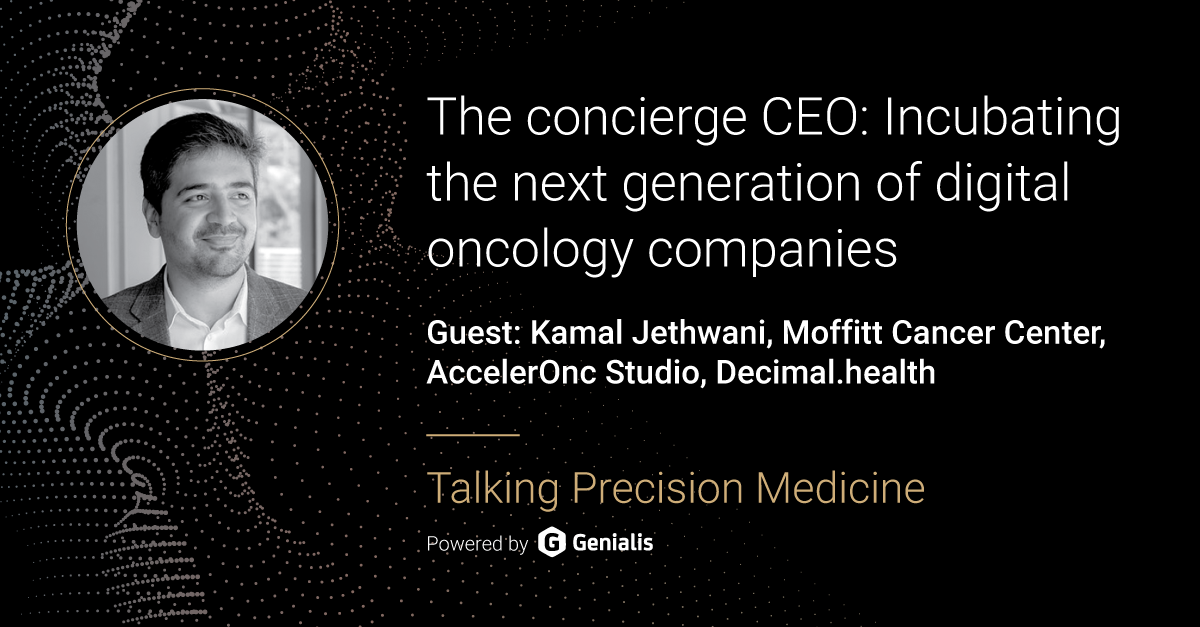
In this episode, Rafael Rosengarten sits down with Dr. Kamal Jethwani, VP of Digital Ventures at Moffitt Cancer Center, CEO of AccelerOnc Studio, and consulting CEO of Decimal Health. With over two decades in digital health, Kamal shares how Moffitt is transforming cutting-edge oncology expertise into scalable AI-native companies, why operational implementation matters more than most founders realize, and how digital health adoption succeeds or fails inside real clinical workflows. From “concierge MVPs” to explainable AI, the conversation covers the hard-won lessons of building digital health programs at the ground level and why oncology innovation may be entering a completely new era.
Come on in and have a listen.
Episode highlights:
Turning Moffitt’s oncology expertise into scalable companies
- Moffitt’s Office of Entrepreneurship was built to take the cancer center’s clinical and research innovations beyond its walls, reaching health systems, pharma, payers, and patients worldwide.
- A fifteen-year investment in data infrastructure produced one of the country’s largest longitudinal oncology datasets, and co-locating clinicians with AI scientists has become the engine behind most of its IP.
- AccelerOnc Studio brings nine operational functions on day one, all fractional, so founders can move fast without over-hiring.
“If we were to make physical capacity and physician capacity a non-issue and were able to get all of our expertise and our know-how to every single patient in the world, how would the world look different?”
Why implementation determines whether great products survive
- A heart failure monitoring program at Mass General cut thirty-day readmissions by fifty percent in pilots, then drew just two or three physician referrals a month in the real world because enrollment had been left to already-stretched clinicians.
- Switching to opt-out and handing enrollment to a coordinator pushed adoption to ninety percent of eligible patients within sixty days and generated four and a half million dollars in savings that year.
- The takeaway: workflow redesign often matters more than the product, and knowing exactly who does what at each step of deployment is not optional.
“When I think about a company, my biggest thing is operational implementation. If you fail, your product can be the best thing since sliced bread and no one’s going to look at it.”
The concierge MVP: building products people actually use
- Kamal’s approach is to augment early technology with human support rather than trust it to carry users through friction alone, including sending staff to patients’ homes each morning for the first three days to ensure three consecutive readings were taken.
- Three readings was the threshold: once patients crossed it, ninety percent adherence over the next three months was nearly guaranteed.
- Those early visits also surfaced the small, unsexy obstacles that data never would, and that insight shaped how the program was eventually automated and scaled.
“I want to make an MVP, which is minimally viable, at least. But I don’t want to trust the tech to be viable. I’m going to augment it with concierges that make it feel better. And slowly you get the training wheels out.”
Designing healthcare companies around economics, not just outcomes
- Selling into a health system means addressing five or six buyers and four or five influencers at once, each with a different definition of value: clinical, financial, technical, and patient-facing.
- Kamal’s bar for taking on a company is a crisp economic story: two hundred dollars per patient in, two thousand four hundred dollars back within three months, with the exact line item named.
- Every engagement includes a real-time measurement offer and an invitation to co-publish, something hospitals reliably say yes to.
“For a two hundred dollar investment in this per patient, I’m going to return two thousand four hundred dollars for you in three months.”
How explainable AI revealed an unexpected clinical insight
- A readmission prediction model built with Hitachi around 2011 kept flagging the word “milk” as a top risk factor, and no one on the clinical team could explain it.
- After digging in, cardiologists traced it to milk of magnesia, the go-to constipation treatment, which was causing patients to stop their medications, which was driving the readmissions.
- The pattern had been sitting in decades of data unnoticed, and that moment convinced Kamal that AI finds things humans simply cannot.
“This is something that humans cannot do and we’ve had decades of experience with cardiologists on it. And I don’t think people have put two and two together, which is really interesting.”
AI as table stakes, and the long game for oncology
- Nearly every company coming out of AccelerOnc is either AI-native or deeply AI-enabled, and AI agents are running internally across coding, lead generation, customer operations, and business development.
- Oncology is one of the areas where conviction in AI’s transformative potential runs strongest, and Kamal sees that belief only growing.
“If we can make it so that no one has to die of cancer, and we make it a chronic disease, I think we would have won.”
This has been Talking Precision Medicine. Please subscribe and share our podcast with your colleagues, leave a comment or review, and stay tuned for the next episode. Until then you can explore our TPM podcast archive and listen to interesting guests from our past conversations.