
Welcome to Talking Precision Medicine (TPM podcast) — the podcast in which we discuss the future of healthcare and health technology, and how advances in data and data science are fueling the next industrial revolution.
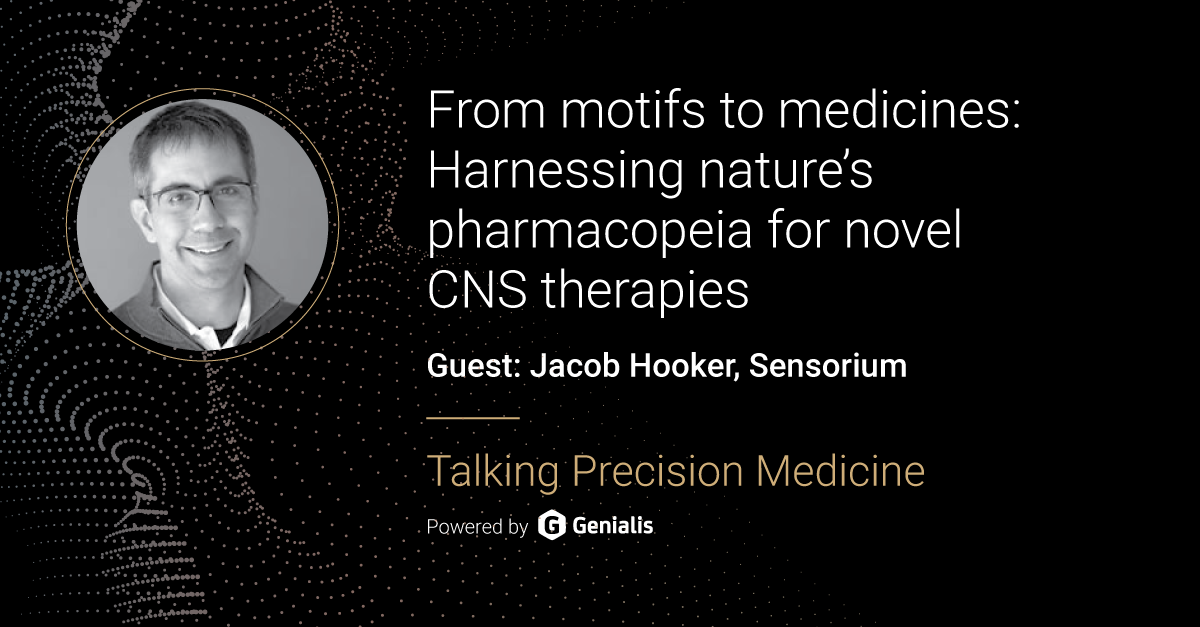
Mental health remains one of medicine’s greatest unmet needs. In this episode, Jacob Hooker explains how Sensorium Therapeutics is searching for new psychiatric medicines by combining traditional plant knowledge with cutting-edge drug development. Jacob joins Rafael to discuss how centuries of ethnobotanical knowledge, modern AI, and medicinal chemistry are helping uncover new treatments for anxiety, epilepsy, and cognitive disorders. Along the way, they explore the science behind psychoactive plants, the growing global burden of mental health conditions, and what the future of psychiatric medicine could look like if researchers can move beyond symptom management toward lasting brain health.
Come on in and have a listen.
Episode highlights:
The enduring value of ethnobotany
- Jacob traces the roots of Sensorium’s approach to ethnobotany, the study of how humans have used plants throughout history.
- He discusses pioneers such as Richard Evans Schultes and the generations of researchers who documented traditional knowledge about medicinal and psychoactive plants.
- Much of this information exists in oral traditions, historical texts, and cultural practices that predate modern medicine by centuries.
- For Jacob, these records represent a vast repository of biological insight that remains largely unexplored by contemporary drug discovery
“The intersection of human behavior with nature and the knowledge that’s taken hundreds to thousands of years to develop.”
Building Sensorium from motifs to medicines
- Sensorium was founded to investigate psychoactive natural products that fall outside the traditional psychedelic category but may still have therapeutic value.
- The company focuses on identifying compounds with compelling evidence of human use and translating those observations into modern drug development programs.
- Today, Sensorium is advancing a pipeline that includes programs in anxiety disorders, drug-resistant epilepsy, and cognitive enhancement.
- The company’s mission is rooted in a simple idea: discover promising biological motifs in nature, then transform them into medicines that can be rigorously tested in the clinic.
“What Sensorium fundamentally does is it looks for discovery patterns, rediscovery patterns of psychoactive plants.”
Using AI to connect centuries of knowledge
- Sensorium aggregates information from oral traditions, historical texts, ethnobotanical records, and modern scientific publications.
- The team organizes these connections into a large knowledge graph that captures relationships between plants, compounds, biological targets, and human experiences.
- Large language models and machine learning tools help identify patterns, fill knowledge gaps, and generate new hypotheses for drug discovery.
“It’s really the relationships between data that give us power. It’s not necessarily just the data itself.”
Turning natural products into medicines
- Natural compounds often have unique biological activity but are not optimized to function as modern pharmaceuticals.
- Sensorium modifies promising molecules to improve absorption, metabolism, brain penetration, and safety while preserving their therapeutic potential.
- Jacob discusses the balance between computational tools and traditional medicinal chemistry when working with complex natural product structures.
“The preferred Western context for how we treat people is a pill a day. And nature didn’t design it that way.”
Why anxiety remains a massive unmet need
- Anxiety disorders are the most prevalent mental health condition globally and continue to grow in prevalence.
- Existing treatments often require patients to endure weeks of uncertainty before knowing whether a medication will help.
- Many commonly prescribed therapies come with significant side effects, including weight gain, sexual dysfunction, sedation, or dependence.
- Anxiety frequently overlaps with depression, epilepsy, and other neurological and psychiatric disorders.
“Thirty percent of the world’s population will have a diagnosis of an anxiety disorder sometime in their life.”
The changing landscape of psychiatric medicine
- Public attitudes toward psychoactive therapies are shifting as new clinical evidence emerges.
- Large pharmaceutical companies are once again investing in neuroscience and psychiatric drug development after years of reduced activity.
- Jacob argues that growing awareness of mental health challenges is creating momentum for novel mechanisms and treatment approaches.
“We’re maybe two or three years into a ten year cycle where psychiatry in particular is exciting to people again.”
Moving beyond daily symptom management
- Jacob believes the future of psychiatry lies in treatments that produce durable benefits rather than requiring lifelong daily medication.
- Emerging evidence from psychedelics, ketamine, and related therapies suggests lasting changes in brain function may be possible.
- The ultimate goal is to help patients fundamentally rewire maladaptive patterns instead of simply suppressing symptoms.
“We should have discovered what are the mechanism features, what are the ways of engaging with the human brain that drive durability, that really help people rewire their brain, not just patch over daily symptoms.”
This has been Talking Precision Medicine. Please subscribe and share our podcast with your colleagues, leave a comment or review, and stay tuned for the next episode. Until then you can explore our TPM podcast archive and listen to interesting guests from our past conversations.