
Welcome to Talking Precision Medicine (TPM podcast) — the podcast in which we discuss the future of healthcare and health technology, and how advances in data and data science are fueling the next industrial revolution.
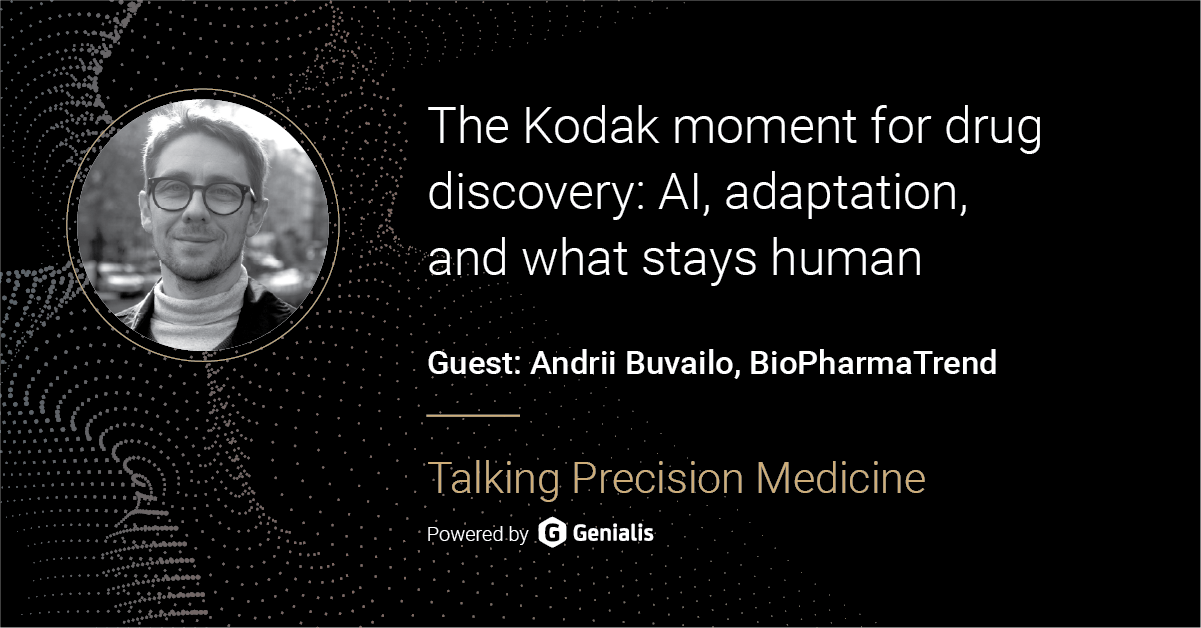
Are we measuring progress in AI-driven drug discovery the right way? Rafael Rosengarten explores this question with Andrii Buvailo, co-founder of BioPharmaTrend and one of the industry’s most perceptive analysts of AI in biotech and pharma. They trace the evolution of AI-driven drug discovery, examine why counting AI-discovered drugs gives an incomplete picture of progress, and explore where AI can create value today. Andrii also considers why the technology has become so polarizing, what remains distinctly human in an AI-enabled world, and how patient data and more representative biological systems could reshape drug development.
Come on in and have a listen.
Episode highlights:
From side project to industry intelligence platform
- Andrii launched BioPharmaTrend in 2016 while leading digital marketing and e-commerce initiatives at Enamine.
- His background in chemistry, programming, and commercial operations gave him a distinct perspective on emerging drug discovery companies.
- What began as a personal interest in deep learning and medicinal chemistry eventually developed into a media and consulting business.
“I never expected it to be a business. But then it just, you know, took off.”
How AI in drug discovery has evolved
- The first generation of AI companies largely applied deep learning to specific tasks such as molecular design, virtual screening, and bioinformatics.
- These early point solutions gradually developed into broader software suites and computational platforms.
- Transformer architectures and general-purpose models created a new layer capable of connecting specialized tools, data, and workflows.
“The first wave gave understanding of how to apply machine learning to point problems. And then this new wave is a way to connect the dots.”
Looking beyond the AI-discovered drug
- Attributing a drug entirely to AI is difficult because candidates emerge from long, collaborative processes involving both computational tools and human decisions.
- Counting clinical-stage assets therefore provides only a narrow and potentially misleading measure of AI’s impact.
- More useful indicators may include R&D productivity, better pipeline decisions, faster failure of weak candidates, and measurable adoption of AI software.
“In my opinion, counting candidates is not the way to measure success or unsuccessful pathway.”
Where AI can deliver value today
- AI may create its most immediate impact by reducing the operational burden surrounding research and clinical development.
- Promising applications include reviewing extensive documentation, improving trial design, selecting patients, analyzing biomarkers, and identifying potential problems before experiments begin.
- General-purpose models can also help scientists synthesize unfamiliar research and work across disciplines without replacing specialized scientific tools.
“It’s a very powerful tool that just gives you the ability to search across data sets, across modalities, across millions of documents, which wasn’t possible even like five years ago.”
What remains distinctly human
- As basic information becomes increasingly commoditized, media organizations must offer analysis, exclusive data, informed judgment, and firsthand reporting.
- Writers and scientists need to understand AI’s capabilities well enough to decide where it improves their work and where human involvement remains essential.
- Expertise will increasingly involve finding the right balance between productivity, ethics, originality, and audience expectations.
“So the best thing that people can do is of course make it their second job, if you will, to try to understand what is possible and what is not.”
Why the technology became polarizing
- AI companies promoted anthropomorphized narratives about existential risk that overshadowed the technology’s practical value and alienated parts of the public.
- Artists and other creators saw their work used to train systems that could compete with them, intensifying concerns about copyright, compensation, and displacement.
- Unequal access to computing infrastructure and dependence on foreign model providers turned AI into a geopolitical and strategic risk, particularly in Europe.
“Probably the most surprising thing was the fact that such a great technology could be such a nuanced and polarizing force eventually.”
The next era of AI-enabled biopharma
- Companies may move away from relying on a single frontier model and adopt smaller, less expensive models tailored to specific tasks.
- Drug development could shift from reductionist target-and-ligand approaches toward whole-system models of cells, tissues, and interconnected biology.
- Patient samples, organoids, organs-on-chips, and AI systems capable of interpreting their complexity may become central to improving clinical translation.
“The new industry really will be about the patient data, patient samples and AI that can actually wrap its digital head around all that complexity.”
This has been Talking Precision Medicine. Please subscribe and share our podcast with your colleagues, leave a comment or review, and stay tuned for the next episode. Until then you can explore our TPM podcast archive and listen to interesting guests from our past conversations.