
Welcome to Talking Precision Medicine (TPM podcast) — the podcast in which we discuss the future of healthcare and health technology, and how advances in data and data science are fueling the next industrial revolution.
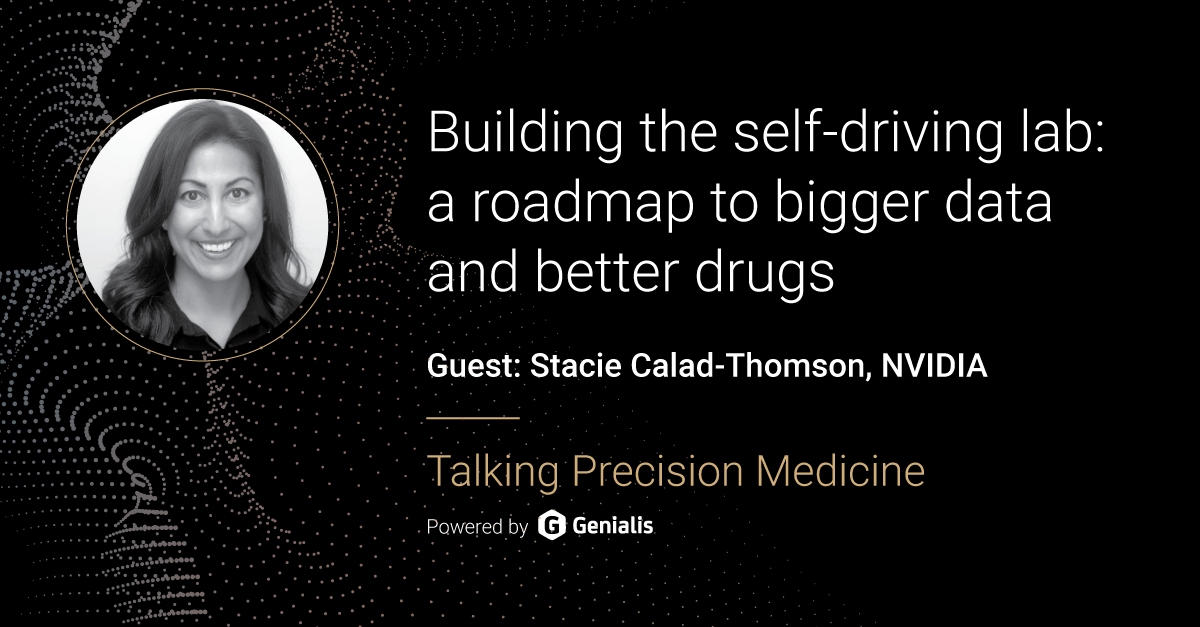
AI can propose a molecule or suggest the next experiment. But someone still has to run the experiment, check the result, and decide what to do with it. In this episode of Talking Precision Medicine, Rafael Rosengarten talks with Stacie Calad-Thomson, Global BD Lead for BioPharma Labs & Manufacturing at NVIDIA about connecting AI to the physical lab. They discuss why consistent experimental data matters, how agents and robotics could work together across a lab, and what scientists will do as more of that work becomes automated.
Come on in and have a listen.
Links:
- NVIDIA AI for Healthcare and Life Sciences
- Thermo Fisher Scientific Announces Strategic Collaboration With NVIDIA Leveraging AI to Advance Scientific Instrumentation and Accelerate Laboratory Performance
- NVIDIA BioNeMo Platform Adopted by Life Sciences Leaders to Accelerate AI-Driven Drug Discovery
- The World’s Most Powerful AI Factory for Pharmaceutical Discovery and Development
- Benchling and HighRes: connecting experiment design to lab automation
- AAIH (The Alliance for Artificial Intelligence in Healthcare)
Episode highlights:
Why the lab is the next bottleneck
- Nvidia’s aim is to help the ecosystem go faster, not to run drug discovery itself.
- AI can suggest targets and molecules, but those predictions still need to be tested in the lab.
- More automated experiments could help fill gaps in what we know about biology.
- The data also needs to be consistent. Results that vary from one assay or lab to another are harder to learn from.
“…because how you set up the experiment is going to result in the quality of data that you get out of that experiment.”
Connecting AI agents to experiments
- An AI scientist agent could act as a thought partner, drawing on expert agents for chemistry, biology, safety, and pharmacology. It could help a scientist work through the literature, sharpen a hypothesis, and decide what to test next. This matters most for startups with limited budgets.
- If it knows which assays, reagents, and instruments are available, it could suggest an experiment the lab can actually run.
- Lab software could then coordinate the work and return the results to the scientist for analysis.
“…humans are definitely still integral in that loop, but we are approaching a point in time where I think AI agents are capable of making these connections.”
The path to self-driving labs
- Stacie’s framework has five phases: intelligent instruments, agentic lab, assisted perception, perceptive robotics, and full autonomy.
- It starts with instruments that can spot changes in data quality and flag when they need maintenance. Later phases add agents, cameras, digital twins, and robots that can move materials between workstations.
- Full autonomy is still some way off. Even the most advanced labs she describes have people involved in the work.
“…there’s a significant amount of lab work that is not automatable.”
Learning from old data and generating new data
- New experiments can help answer questions about biology and test whether a promising molecular design works. Some compounds are made not as drug candidates but to fill gaps in the design space.
- Rafael recalls the debate between building labs to generate new data and making better use of data that already exists. His view is that both matter, but new datasets should now be designed with a purpose in mind.
- There is also much to learn from compounds that failed. GSK once donated data on over two million of them, but getting pharma companies to share proved hard. Lilly’s TuneLab now does this through federated learning, and other consortia pool funding to generate new data together.
- Clinical data is harder to replace. Rafael and Stacie discuss using patient samples to help connect lab findings with what happens in people.
“…where we do need to reuse data, is in the clinical stages, right? … That’s not data we can go out and generate.”
What changes for scientists and patients?
- Moving between chemistry, drug discovery, and computing made Stacie a translator between disciplines.
- She sees AI giving scientists more room to ask questions and explore ideas, with their expertise still central to that work.
- Clinical trials cannot simply scale at the same rate as lab experiments. The hope is to send better candidates into trials and identify the patients most likely to benefit.
“Can we have better clinical trials that are designed for patients that would benefit most from those drugs?”
This has been Talking Precision Medicine. Please subscribe and share our podcast with your colleagues, leave a comment or review, and stay tuned for the next episode. Until then you can explore our TPM podcast archive and listen to interesting guests from our past conversations.