
Welcome to Talking Precision Medicine (TPM podcast) — the podcast in which we discuss the future of healthcare and health technology, and how advances in data and data science are fueling the next industrial revolution.
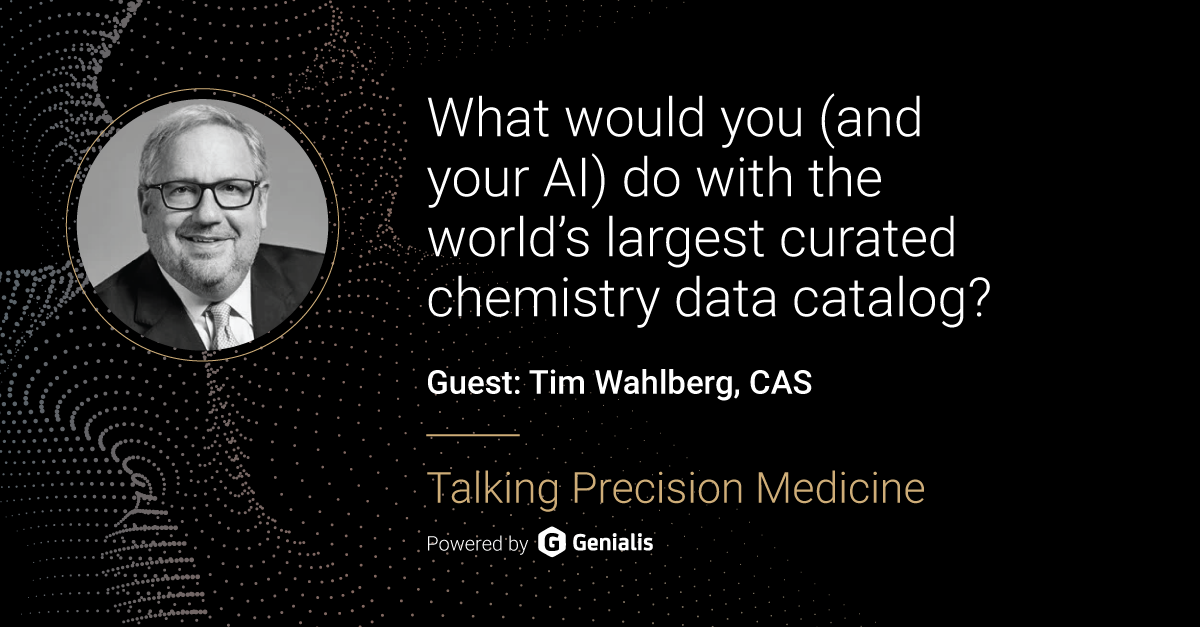
Artificial intelligence may be transforming drug discovery, but AI is only as powerful as the data it learns from. Behind many of today’s scientific breakthroughs sits an invisible layer of expertly curated, harmonized knowledge that allows researchers to ask better questions and trust the answers. In this episode, Rafael speaks with Tim Wahlberg, Interim President of CAS, about why scientific data curation remains essential in the age of large language models, how CAS has evolved from Chemical Abstracts Service into a global scientific intelligence platform, and why the future of AI in science depends as much on data quality as on model sophistication.
Come on in and have a listen.
Episode highlights:
From chemical abstracts to scientific intelligence
- CAS has evolved from manually abstracting chemistry papers into one of the world’s largest scientific knowledge organizations.
- Today it curates scientific literature, patents and chemical information used across pharmaceutical companies, academia and government.
- The organization has expanded well beyond chemistry into life sciences, materials science and AI-ready scientific data.
“The information asset that’s here is what really motivated me to join. It’s one of the most unique databases in the world.”
Why AI still depends on human experts
- Automation has transformed scientific curation, but humans continue to tackle the most complex and nuanced scientific problems.
- Machine learning removes repetitive work while allowing experts to focus on higher-value interpretation.
- As chemistry and biology become increasingly intertwined, expert oversight becomes even more important.
“Every year they focus more and more on the more important, the more complicated activities.”
The hidden challenge: making scientific data usable
- Drug discovery doesn’t simply require more data; it requires data that is organized and connected.
- Harmonizing compounds, proteins, diseases and biological information makes AI systems far more effective.
- CAS acts as a scientific “Rosetta Stone,” helping researchers work across different data sources and representations.
“Whether you have a big data set or a small data set, the harmonization is the underlying data issue.”
Beyond ChatGPT: building science-smart AI
- General-purpose LLMs are valuable for summarization and reasoning but struggle with highly specialized scientific questions.
- CAS combines frontier AI with structured scientific knowledge to improve precision.
- Scientists increasingly access CAS data through AI assistants, enterprise search and knowledge management systems rather than traditional search interfaces.
“We think about it as science smart AI.”
Making scientific search more intuitive
- Scientists no longer need to learn database-specific syntax to perform sophisticated searches.
- LLMs help translate natural language questions into precise scientific queries across curated datasets.
- Researchers spend less time learning search tools and more time exploring scientific evidence.
“People have always wanted to write a query in their native language.”
Looking ahead: connecting the entire scientific ecosystem
- Future breakthroughs will come from connecting biological, chemical and computational models rather than optimizing individual AI systems.
- Quantum computing may eventually help solve today’s most computationally demanding chemistry problems.
- Similar advances will accelerate sustainable materials, green chemistry and next-generation manufacturing alongside drug discovery.
“Each of these little problems that get solved gets lumped together into these amazing, transformative things that it’s hard to conceive of but are, I think, will happen.”
This has been Talking Precision Medicine. Please subscribe and share our podcast with your colleagues, leave a comment or review, and stay tuned for the next episode. Until then you can explore our TPM podcast archive and listen to interesting guests from our past conversations.