
Genialis™ Supermodel
A foundation model of cancer biology
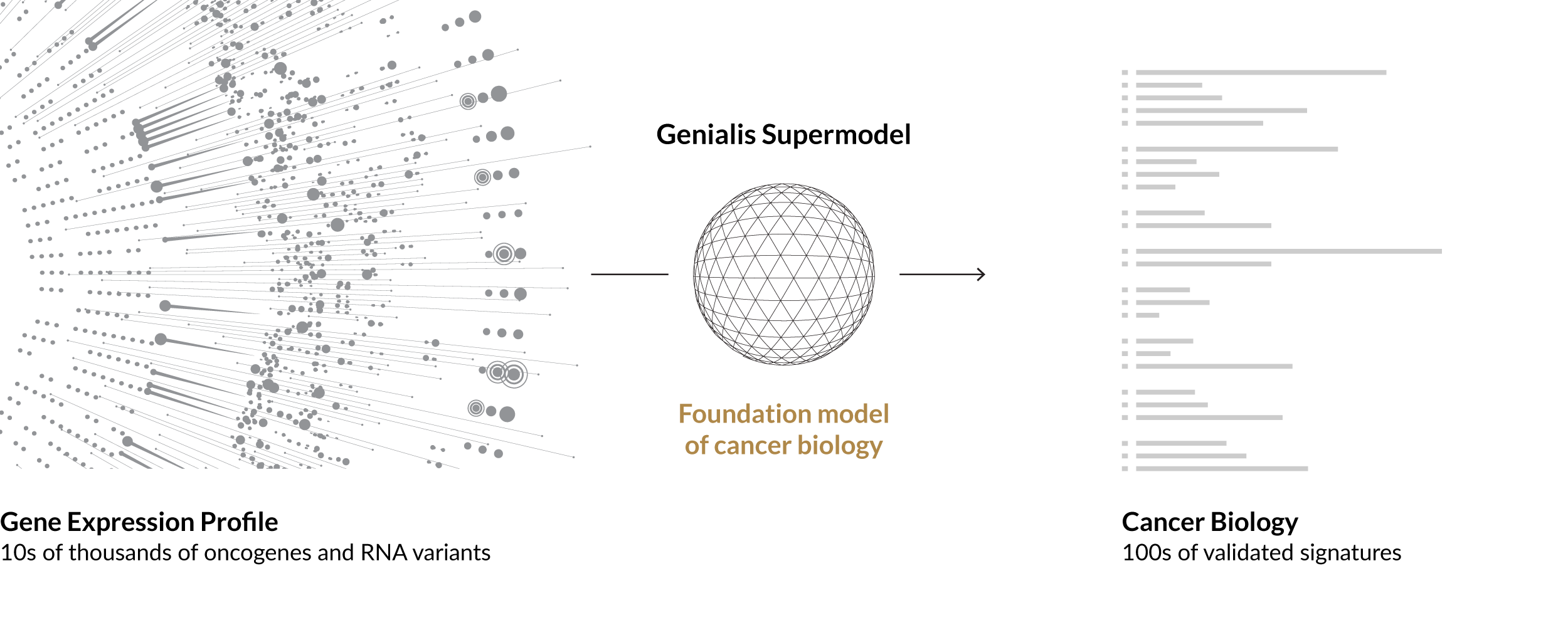
Trained on ~ half a million RNA sequencing samples from over 30 tissue types, this large molecular model (LMM) defines a comprehensive landscape of cancer biology, learned from preclinical experiments and globally diverse patient records. The LMM maps each new patient sample based on its biological state, revealing underlying drivers and vulnerabilities.

The Genialis Supermodel delivers therapeutic intelligence by interpreting the molecular biology of tumor samples. The output are “biomodule” scores, algorithmic representations of over 150 biological phenomena, states, and processes. These include pathway activity, oncogene and transcription factor regulation, gene dependency, tumor microenvironment, cell state, DNA damage response, replication stress, and more.
Technically, the Supermodel is a compendium of phenotypic embeddings that serve as input features for machine-learning modelling of predictors. It is not a black-box, but an intrinsically interpretable biological space. Practically, the Supermodel enables your translational and clinical teams to interrogate questions about response, mechanism, durability, indication, prognosis, … virtually any prediction task.
Biomodule scores can be used to train predictors that:
Accessing the Genialis Supermodel
The Supermodel can be accessed on our cloud or deployed on yours, plugged into your existing data and AI ecosystem. Supermodel inference can be done in milliseconds per sample on a standard desktop computer.
We’ve built an industrial-grade software stack that complements existing solutions, while rich APIs allow the Supermodel to autonomously contribute to established research workflows.
In addition, Genialis provides AI-enabled expert services to assist with technology integration, data processing, and AI design, modeling, and interpretation.
Genialis Supermodel workflow
A typical workflow has four main phases:
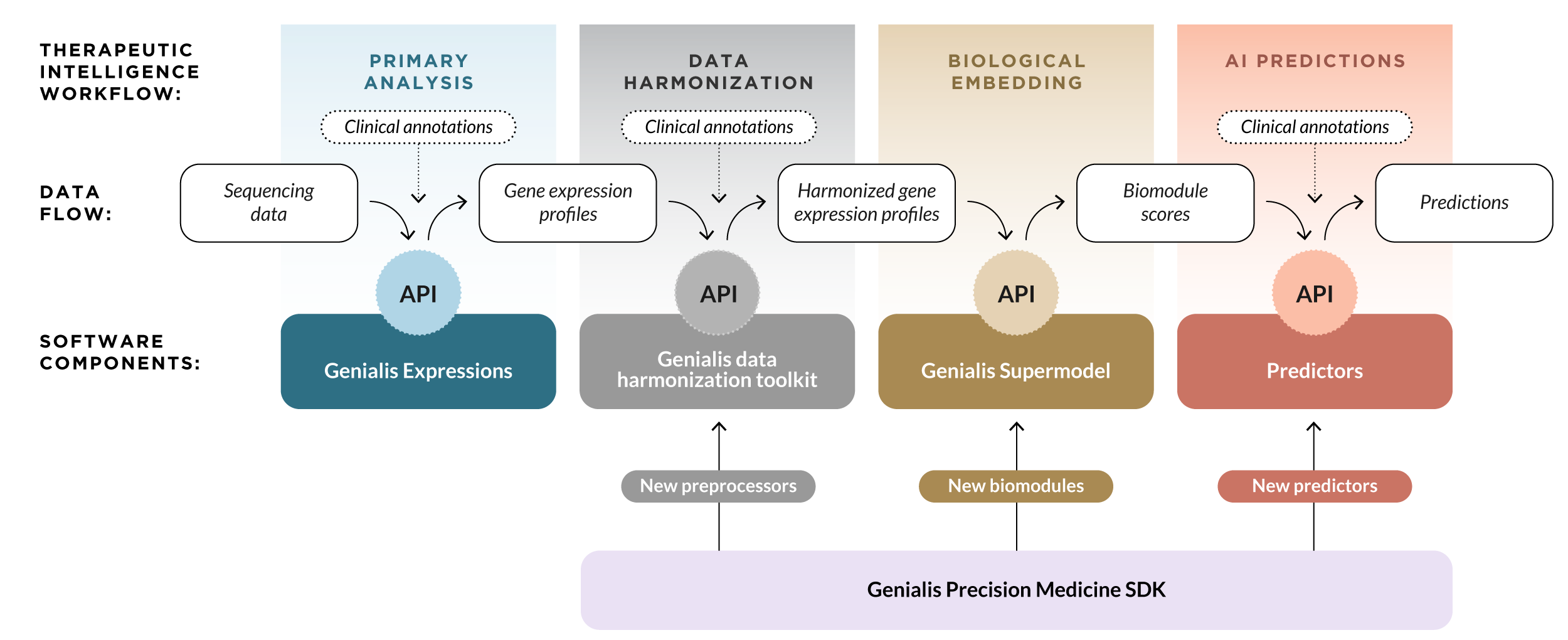
Four key software components support this workflow:
Each of the software components comes with an API allowing bundled or independent deployment and integration of these components within existing architectures.