Welcome to Talking Precision Medicine (TPM podcast) — the podcast in which we discuss the future of healthcare and health technology, and how advances in data and data science are fueling the next industrial revolution.
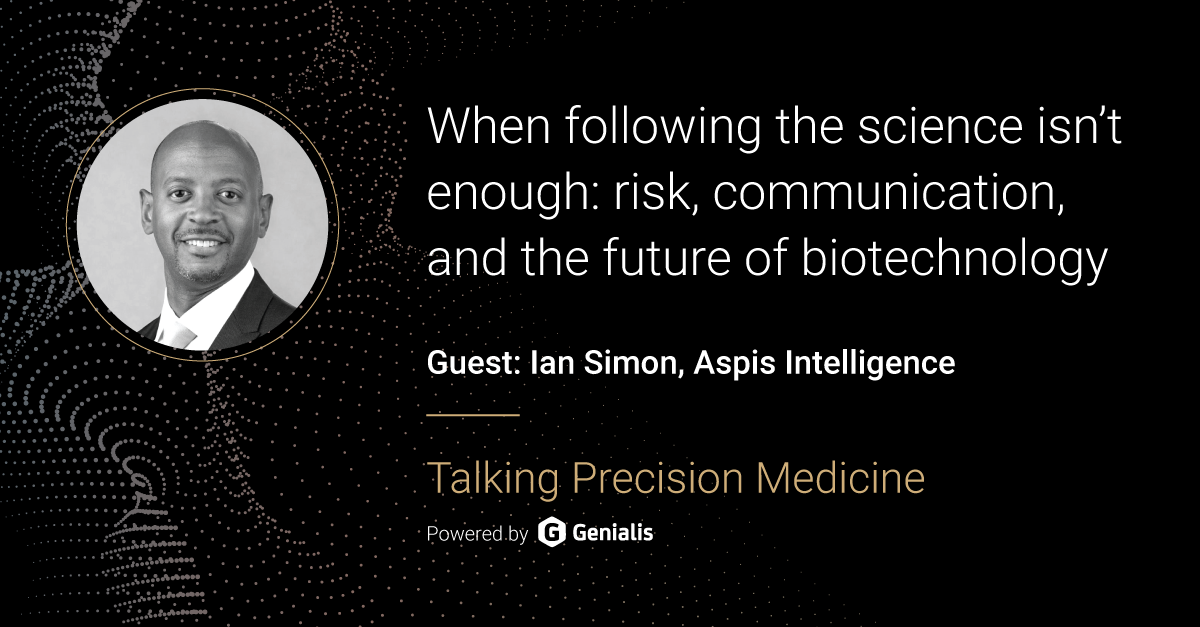
In this episode, I’m joined by my longtime friend Ian Simon, Head of Biotechnology at Aspis Intelligence. Ian’s path runs from grad school vaccine research at Yale to senior roles at the White House, HHS, NIH, the State Department, and the Office of Long Covid. We talk about de-risking young biotech companies, what Covid taught us about science and public health, and how new technologies like AI might change how we do science altogether.
Come on in and have a listen.
Episode highlights:
Helping biotechs see the risks they’re not looking for
- Aspis helps biotechs identify blind spots beyond standard business risks, including vulnerabilities in supply chains, cyber exposure, regulatory shifts, and insider or reputational threats.
- Their model blends deep risk assessments with continuous monitoring to surface hidden issues tied to new technologies, global operations, and complex partner networks.
- By giving leadership a clearer view of emerging threats, Ian and his team enable companies to make smarter decisions before minor exposures escalate into major problems.
“We work with biotech companies that think about how to de-risk lots of different parts of their operation outside the typical business risk.”
From vaccine vector to Ebola and pandemic policy
- Ian’s PhD work on a VSV viral vector (or vesicular stomatitis virus) unexpectedly became the basis of the first licensed Ebola vaccine years later.
- That experience led him into pandemic preparedness work at the White House, collaborating with CDC, NIH, DoD, and others.
- His expertise helped shape early policies on antivirals, vaccines, and how to plan for future outbreaks.
“My PhD thesis was on trying to develop a vaccine platform… and that actually became the first licensed vaccine against Ebola.”
Covid-19: A vaccine success and a public health failure
- Ian sees the Covid-19 vaccines as a major scientific success, enabled partly by lucky timing of prior antigen stabilization research and rapid global collaboration.
- At the same time, he describes the U.S. public health system as unprepared for distribution, implementation, and communication, turning a scientific win into an uneven national response.
- Early confidence in the vaccine created the impression that the hardest work was already done, which left critical follow-through on distribution, uptake, and public-health coordination insufficient and contributed to backlash and mistrust.
“We had a scientific success… and the public health response, at least in the United States, was as close to a failure as you could probably get.”
Long Covid and millions still left behind
- An estimated five to eight percent of people infected with Covid go on to develop long-term symptoms.
- Ian describes Long Covid patients experiencing severe, debilitating fatigue, often accompanied by nausea, vertigo, and cognitive impairment ranging from “brain fog” to more serious neurological effects, including temporary loss of speech, loss of vision, and loss of basic executive reasoning and executive functioning for months.
- While research funding exists, many patients still lack support navigating a fragmented health care and disability system.
“Approximately fifteen to seventeen million Americans are still dealing with these debilitating causes.”
Why ‘follow the science’ is not enough
- Ian argues that simply saying “follow the science” fails to explain how evidence connects to real decisions in people’s lives.
- Misinformation spreads faster because it taps emotions, whereas scientific messages are often dry and poorly framed.
- Scientists are frequently “blank canvases” in public perception, making it easy for others to define the narrative around them.
“Follow the science” does not do what you need it to do to communicate and convey. What is the basis for downstream decision making? How does science impact people’s lives? How does it impact people’s choices? What does it mean to them when science says x versus y? And I think we don’t do enough of that.”
A hopeful vision: AI, automated science, and failing faster
- Ian imagines a near future in which AI and automated experimentation let scientists test vastly more hypotheses in less time.
- Negative data will be captured and reused rather than thrown away, speeding up discovery.
- He believes this will change not just the speed of science but the way science is done.
“We’ll be able to fail faster, so then succeed faster.”
This has been Talking Precision Medicine. Please subscribe and share our podcast with your colleagues, leave a comment or review, and stay tuned for the next episode. Until then you can explore our TPM podcast archive and listen to interesting guests from our past conversations.