
Welcome to Talking Precision Medicine (TPM podcast) — the podcast in which we discuss the future of healthcare and health technology, and how advances in data and data science are fueling the next industrial revolution.
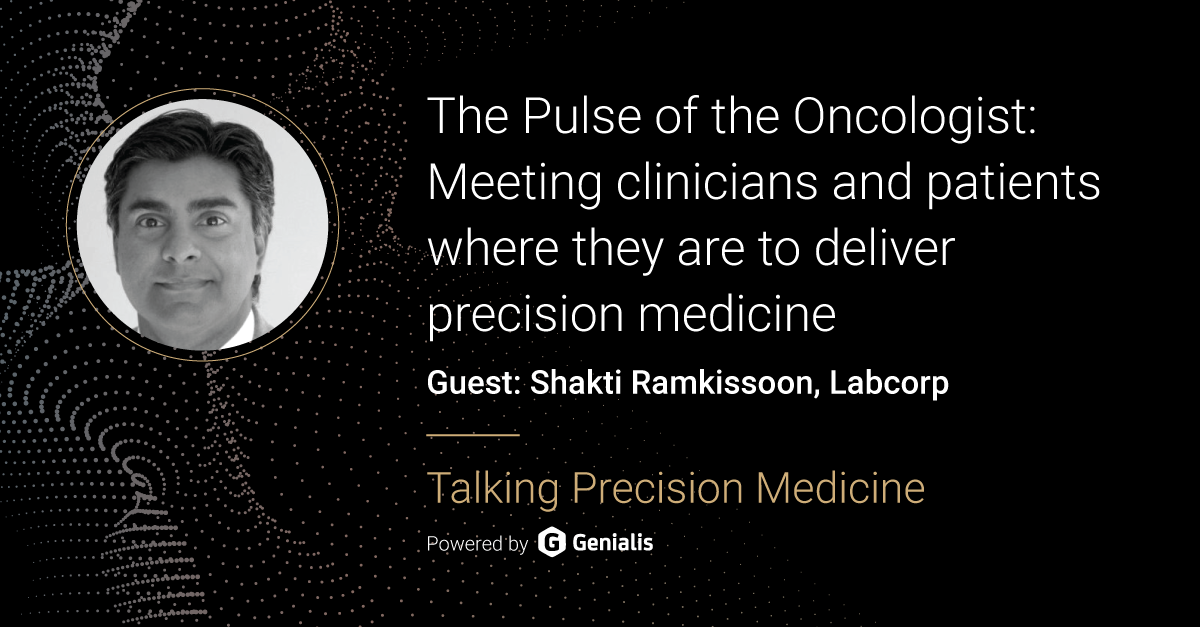
Precision oncology promises more data, more insight, and better decisions, yet in practice it often brings more complexity. In a new episode Rafael Rosengarten is joined by Dr. Shakti Ramkissoon, VP of Oncology at Labcorp, to unpack the realities on the ground. From access gaps, reimbursement challenges and fragmented workflows to the promise of longitudinal data and AI-enabled clarity, Dr. Ramkissoon shares how Labcorp is working to simplify complexity while preserving what matters most: human connection in care.
Come on in and have a listen.
Episode highlights:
Dr. Ramkissoon’s background and mission at Labcorp
- He is a pathologist by training, specializing in anatomic pathology and neuropathology, with deep expertise in brain tumors
- During his early work, he saw firsthand how access to sequencing could fundamentally change diagnoses and patient outcomes
- Today, he is focused on scaling precision oncology at Labcorp and making it easier for clinicians to access and use these tools
“My mission is how to make things as simple as possible for oncologists or pathologists taking care of patients, by making it really easy to work with Labcorp.”
2026 Pulse of the Oncologist report overview
- The report is based on a survey of over 150 oncologists and pathologists across both community and academic settings
- It was designed to capture what clinicians are actually dealing with day to day, from gaps in testing to workflow challenges
- These insights directly shape how Labcorp thinks about supporting better, more practical clinical decision-making
“We don’t want to create things in a vacuum and then get out into the real world and have oncologists say, ‘this is great, but it’s not useful.’ That doesn’t make sense, right?”
Time is the critical currency
- Time pressure shows up everywhere, from waiting on results to managing complex ordering workflows and patient anxiety
- Clinicians often have to navigate fragmented systems, juggling multiple logins and manual coordination just to get tests ordered for their many patients
- When pieces of data fall through the cracks, treatment decisions are made with incomplete information
“Oncologists end up making decisions with the information they have, not the information they wish they had.”
Innovation without access
- Innovation across biomarkers, liquid biopsy, and digital tools is moving fast, but access to it is far from equal
- Many clinicians in community settings, where the majority of patient care is delivered, still struggle to get the same level of testing available at academic centers
- Labcorp is working to bridge that gap by bringing advanced capabilities to patients wherever they are
“There are becoming two groups: those who have access to all the new technologies and capabilities, and those who don’t.”
Digital friction and the future of care
- Digital tools are evolving quickly, creating new opportunities while also adding friction to already complex workflows
- AI is starting to unlock deeper insights from pathology and clinical data that were previously out of reach
- The real challenge is making all of this work seamlessly within everyday clinical practice
“Sometimes… it’s hard to find the report. Is this the report? Is this the most recent one?”
From data to clarity: longitudinal data and interpretation
- Longitudinal data has the potential to reveal much more than isolated test results, especially when patterns emerge over time
- In reality, fragmented reporting still makes it hard for clinicians to see the full picture of their patient’s health and act on it
- Labcorp is focused on bringing everything together through unified reports and added interpretation to support clearer, more actionable decisions
“If you don’t add a layer of interpretation, how to put it together with what’s known, what the literature says, or how to act on it, it can end up creating a lot of confusion.”
Human connection and the future of oncology
- Growing complexity and administrative burden are taking time away from meaningful patient interactions
- The goal of technology should be to give that time back and support more focused, human conversations between physicians and patients
- Looking ahead, the vision is a simpler, more streamlined care pathway, potentially driven by blood-based diagnostics and faster decision-makings
“When I think of laboratory medicine and precision oncology testing, when it’s done right, it actually kind of fades into the background.”
This has been Talking Precision Medicine. Please subscribe and share our podcast with your colleagues, leave a comment or review, and stay tuned for the next episode. Until then you can explore our TPM podcast archive and listen to interesting guests from our past conversations.