
Welcome to Talking Precision Medicine (TPM podcast) — the podcast in which we discuss the future of healthcare and health technology, and how advances in data and data science are fueling the next industrial revolution.
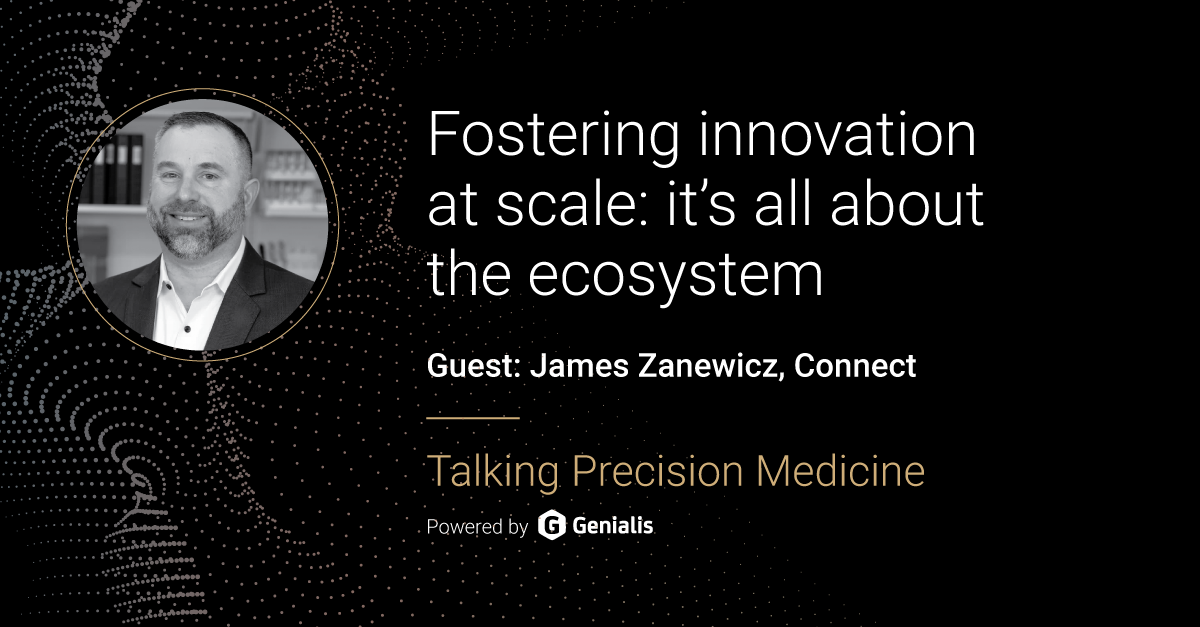
In episode 58, Rafael sits down with James Zanewicz, CEO of Connect, to discuss the art and science of building innovation ecosystems. From Connect’s origins as the world’s first accelerator to the future of AI-powered healthcare, James shares lessons from a career spanning science, law, technology transfer, academic medicine, and ecosystem development. Together, they explore what makes San Diego a global innovation hub, why collaboration matters more than competition, and how organizations can create the connective tissue that helps ideas become impactful.
Come on in and have a listen.
Episode highlights:
Why San Diego became a global innovation hub
- San Diego’s innovation ecosystem was intentionally built through collaboration among academia, industry, investors, and civic leaders.
- A culture of cooperation encourages founders and companies to support one another because success strengthens the entire community.
- Connect’s model has influenced innovation ecosystems across more than fifty countries.
“San Diego actually came together and chose to build the ecosystem.”
Why ecosystems need connective tissue
- Great ideas and talented founders are not enough if they struggle to find the right partners, investors, or customers at the right moment.
- Connect sees its role as helping people navigate increasingly complex innovation landscapes without bias or hidden incentives.
- As ecosystems mature, coordination becomes just as important as invention.
“We help that ecosystem behave more like an ecosystem should.”
From chemistry to ecosystem leadership
- James reflects on a career journey that crossed disciplines and industries before leading one of the most influential innovation organizations in the world.
- Moving between chemistry, law, media, technology transfer, and academic medicine helped him develop a broad view of how ideas become products, companies, and impact.
- He encourages people to embrace new opportunities rather than becoming attached to past accomplishments.
“There is always something new and interesting you can do. If somebody wants what you’ve done, let them have it and go do the other cool new thing.”
The promise and tension of artificial intelligence
- While AI offers enormous opportunities, James and Rafael discuss concerns about what may be lost if people rely on it too heavily.
- AI is increasingly becoming an enabling technology across every industry rather than a standalone sector.
- The ability to automate tasks should not replace human creativity, communication, and critical thinking.
- Future success may depend on finding the right balance between using AI as a tool and avoiding dependence on it as a crutch.
“Are we going to lose our ability to be more human and more creative in some ways?”
Why AI belongs in every industry
- The conversation explores how AI is reshaping everything from finance and law to healthcare and scientific research.
- San Diego’s strength lies not only in developing AI technologies but in applying them across a wide range of industries.
- Healthcare offers one of the clearest examples of how data, technology, and AI are becoming inseparable from scientific progress.
- The next wave of innovation may come from organizations that successfully integrate AI into their operational core.
“AI is not a vertical. AI is something that is in every vertical.”
A new chapter for the Alliance for AI in Healthcare
- The Alliance was created to help healthcare stakeholders understand both the opportunities and challenges of AI.
- Connect is relaunching the Alliance for AI in Healthcare as a global program focused on education and responsible adoption.
- Operating within Connect creates opportunities to expand its reach through an established global innovation network.
- Education remains central to helping regulators, investors, founders, and healthcare leaders navigate a rapidly changing landscape.
“We educate about issues as opposed to advocating for a position.”
What successful innovation looks like
- Looking ahead, James believes the future belongs to organizations and ecosystems that remove friction and connect expertise across traditional boundaries.
- The most successful innovators may not be those with the best technology, but those who integrate technology most effectively.
- Boundaries between healthcare, data science, AI, robotics, and other disciplines will continue to blur.
- Strong ecosystems help entrepreneurs move faster by making expertise, resources, and relationships easier to access.
“The winning ecosystems are not the ones who have the best tech or the smartest person in the room. They’re the ones who figure out how to actively deploy and embrace tech, data, and AI into their operational core.”
This has been Talking Precision Medicine. Please subscribe and share our podcast with your colleagues, leave a comment or review, and stay tuned for the next episode. Until then you can explore our TPM podcast archive and listen to interesting guests from our past conversations.