
Welcome to Talking Precision Medicine (TPM podcast) — the podcast in which we discuss the future of healthcare and health technology, and how advances in data and data science are fueling the next industrial revolution.
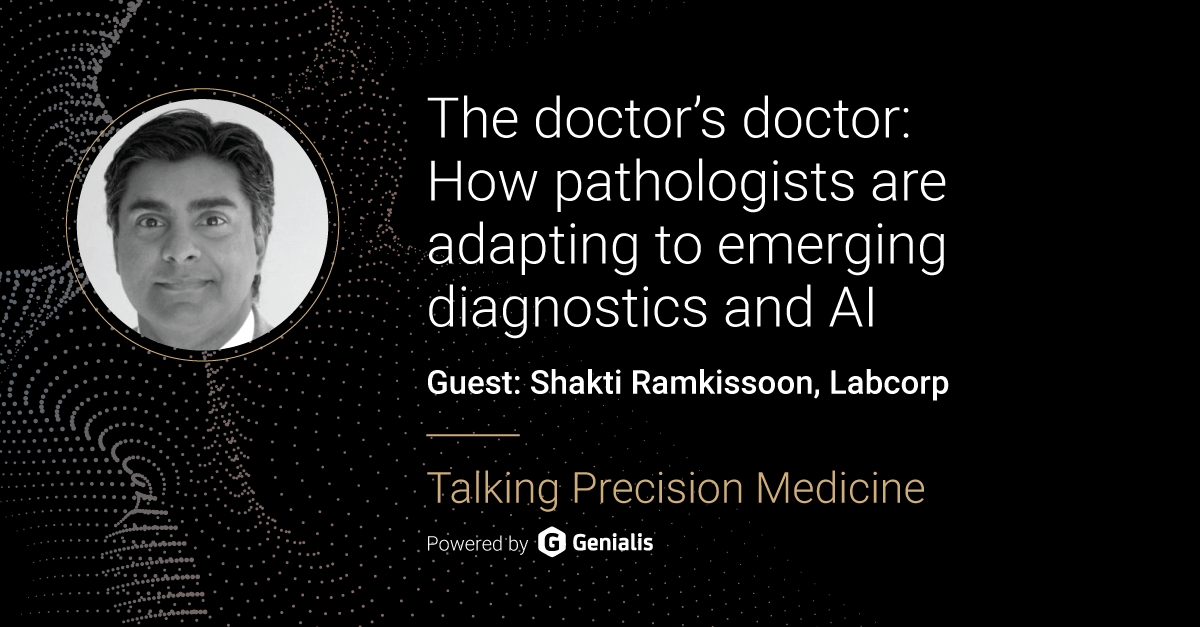
Finding cancer earlier and learning more about its biology creates new possibilities for care. It also creates more work for the pathologists who examine samples, interpret results, and help guide treatment decisions. In this episode of Talking Precision Medicine, Rafael Rosengarten welcomes back Dr. Shakti Ramkissoon, senior vice president, enterprise oncology at Labcorp, to discuss the Pulse of the Pathologist report. Drawing on a survey of 148 practicing pathologists, they explore growing workloads, practical applications of AI, and what it takes to bring new diagnostic tools into everyday care.
Come on in and have a listen.
Episode highlights:
Earlier detection brings more work and greater complexity
- A positive signal from an early detection test starts a diagnostic workup that may involve imaging, biopsies, and further testing.
- Pathologists must bring together information about the tissue, molecular biomarkers, and sometimes inherited cancer risk to help clinicians understand each case.
- Growing demand and persistent workforce shortages are creating pressure to handle more cases efficiently while maintaining diagnostic quality.
“The volumes are going to go up. The cases are going to get more complicated.”
Digital pathology and the changing role of the pathologist
- Digitized slides make it possible to review cases remotely and share them with specialists across locations and time zones.
- Pathologists in training expect digital tools. Experienced pathologists value the flexibility to work without being tied to one location.
- AI could help with repetitive tasks such as counting dividing cells or measuring how much of a tissue sample is necrotic.
- Adoption will be gradual, starting with routine tasks and moving into more complex work as trust grows. The aim is to support pathologists, not replace them.
- Automating some of this work could give pathologists more time to interpret findings together and advise the clinicians making treatment decisions.
“You know, we always think of ourselves as the doctor’s doctor kind of in the background. And I think we can lean into that concept more in the coming years because of technology in a way that we’ve not been able to do in the past.”
New tools have to fit the whole workflow
- The main barriers to AI adoption are no longer awareness or trust. They are reimbursement and the cost of setting up new systems.
- Adoption depends on how well a tool fits into daily practice, including laboratory systems and electronic medical records.
- Faster analysis is only part of the process. Sample transport, processing, and getting results back to the right clinician all affect turnaround time.
- Scanners, data storage, staffing, and reimbursement need to be considered together when practices invest in digital pathology. Without reimbursement, only well-resourced practices may be able to adopt these tools.
- At Labcorp, a single scanner and software platform is designed to make it easier to share cases across the network.
“We spent a lot of time thinking about technology and the value of AI and algorithms and digitizing slides. And that’s all really great, but we cannot forget about the workflow around that entire process.”
Blood tests and a deeper look at tumor biology
- Multicancer early detection tests could help identify cancers sooner, alongside established screening methods, but further evidence of clinical utility is needed.
- Molecular residual disease testing looks for signs of remaining cancer after surgery. It adds information to pathology, imaging, and clinical findings and may detect cancer before it is visible on imaging.
- Transcriptomics, spatial approaches, and single-cell sequencing could reveal more about tumor biology and resistance. Like the earlier shift from single-gene testing to comprehensive genomic profiling, their adoption will depend on demonstrating value in specific clinical settings.
“But with MRD now we’re able to actually look post-operatively maybe a couple of weeks after surgery in the blood to see whether or not there’s molecular evidence of residual disease in the patient”
Evidence and reimbursement determine what reaches patients
- Demonstrating that a test works technically is one step. Showing that it informs clinical decisions and improves patient outcomes requires further studies.
- Predictable coverage helps laboratories invest in the people, equipment, and systems needed to offer new testing.
- Generating that evidence takes collaboration among laboratories, clinicians, technology developers, patient advocates, and payers.
- Good evidence can also show where new tests replace older ones, helping to contain overall diagnostic costs.
“We know the problems. How do we generate the evidence to make the change that we want to see?”
This has been Talking Precision Medicine. Please subscribe and share our podcast with your colleagues, leave a comment or review, and stay tuned for the next episode. Until then you can explore our TPM podcast archive and listen to interesting guests from our past conversations.