Welcome to Talking Precision Medicine (TPM podcast) — the podcast in which we discuss the future of healthcare and health technology, and how advances in data and data science are fueling the next industrial revolution.
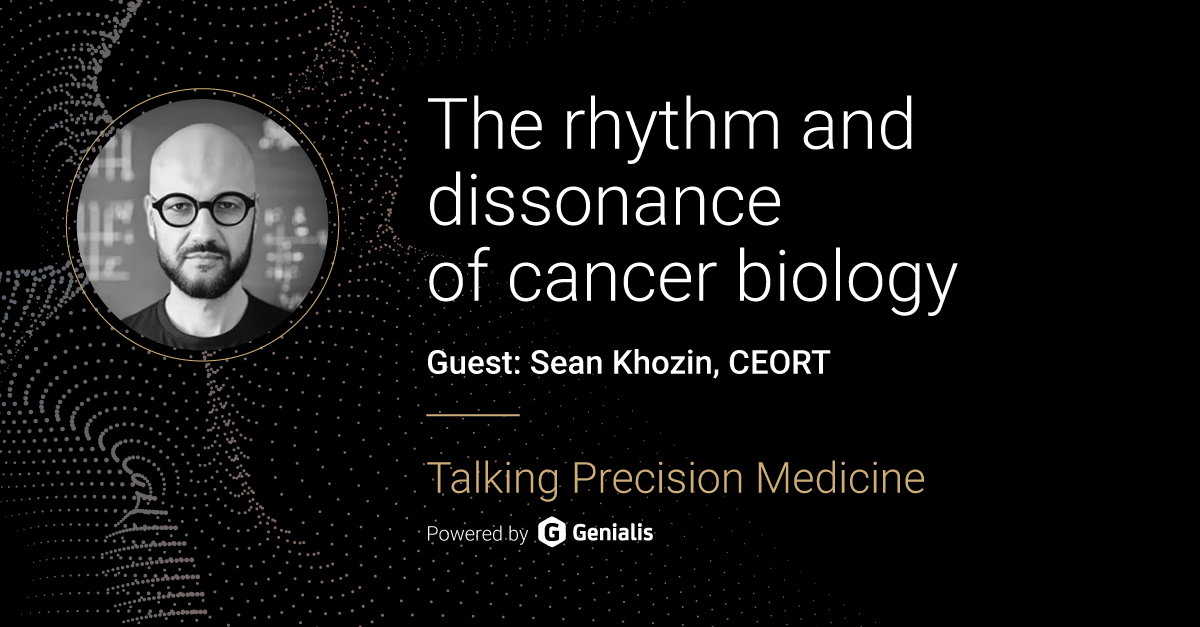
In this episode, Rafael Rosengarten speaks with Dr. Sean Khozin, CEO of the CEO Roundtable on Cancer. Sean shares how pre-competitive collaboration across industry, academia, and regulators is helping address some of the biggest challenges in oncology. The conversation explores the role of data sharing initiatives like Project Data Sphere, the promise of AI in clinical trials and discovery, and Sean’s unique journey from music to science.
Come on in and have a listen.
Episode highlights:
Breaking down silos in cancer research
- The CEO Roundtable on Cancer (CEORT) was founded in 2001 by President George H. W. Bush to foster collaboration across the oncology ecosystem.
- Competing pharmaceutical companies work together in a trusted, pre-competitive environment to address shared challenges in cancer research and care.
- CEORT convenes leaders from industry, academia, government, and investment to discuss common problems in oncology.
“He gathered a group of biopharma CEOs and essentially posed a rather intriguing symbol challenge. And he told them to think about putting competition aside and try to break down the silos that fragment cancer research and care and build something together that none of you, as individual organizations, can build alone.”
Building a safe harbor for collaboration
- CEORT creates a neutral space where stakeholders across the cancer ecosystem can work together.
- The organization brings together decision makers from industry, regulators, academia, and investors to tackle complex problems.
- The model reflects a growing recognition that progress in oncology requires cooperation across traditional boundaries.
“Cancer does not respect corporate boundaries and fragmentation of knowledge itself is a kind of disease.”
Sharing clinical trial data at scale
- Project Data Sphere launched in 2014 as an open clinical trial data sharing platform supported by CEORT member companies.
- The platform allows researchers worldwide to analyze oncology trial data and pursue new scientific questions.
- The initiative has demonstrated how pooled datasets can accelerate research across the oncology community.
“It was an open access data sharing platform with no gatekeepers, quite a radical thought at the time.”
Rethinking clinical trials with AI
- Shared datasets open new possibilities for AI-driven external control arms and digital twins in oncology trials.
- Researchers have explored how pooled clinical trial data could support alternative approaches to building control groups.
- These methods could improve trial efficiency and reduce development costs if widely adopted.
“Being able to have a resource like that would significantly reduce the cost of clinical trials and clinical development.”
From music to medicine
- Before pursuing medicine, Sean seriously considered a career in music and still composes and plays today.
- His early interests in math, programming, and music shaped how he approaches biological systems and artificial intelligence.
- Those influences led him to think about disease and health through patterns and structure rather than traditional clinical categories.
“Homeostasis has a rhythm and a key signature, and when homeostasis starts to be disturbed the harmony becomes dissonant.”
AI and the next era of medical discovery
- AI could automate administrative tasks in healthcare, giving clinicians more time to focus on patients.
- More importantly, advanced models may uncover biological insights that humans cannot easily perceive.
- These capabilities could expand how scientists understand disease and develop new therapies.
“It’s not about doing things faster, although that helps. It’s not about efficiency. It’s about tapping into a world of knowledge that human beings have never had any access to.”
This has been Talking Precision Medicine. Please subscribe and share our podcast with your colleagues, leave a comment or review, and stay tuned for the next episode. Until then you can explore our TPM podcast archive and listen to interesting guests from our past conversations.